Hairline Design: The Single Most Important Decision

A great hairline is a balance of geometry and irregularity. What a good designer measures — frontal point, temple angles, density gradient.
The Single Most Important Decision
Everything else in a hair transplant — graft count, technique, surgeon hands — can be world-class, and the result will still look fake if the hairline is wrong. The hairline is the part of the result the world sees first and forever.
The Anchor Points
A great hairline design measures and respects three anchor points:
- The mid-frontal point — typically 7–10 cm above the glabella (the smooth space between the eyebrows), placed too low looks comical at 50
- The frontotemporal angle — where the hairline meets the temple recession, usually a soft 30–45° wedge
- The temporal peak — the point where the natural temple density returns
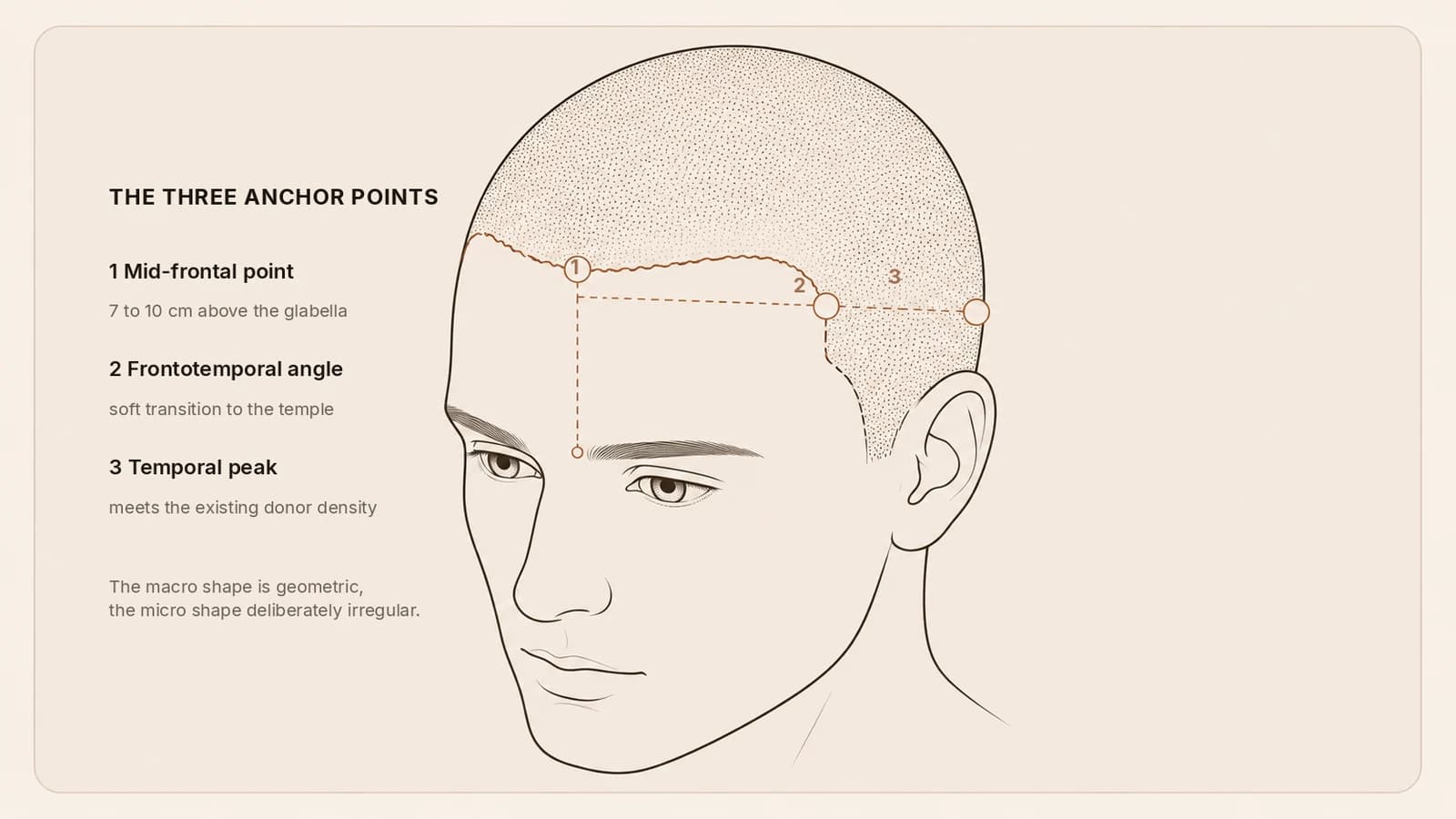
Every good hairline starts at these three points. A ruler-straight line does not exist in nature.
Geometry vs. Irregularity
A hairline that is perfectly straight looks fake. A natural hairline has micro-irregularities: stray hairs that sit forward of the line, slight dips and rises, single-hair fronds that fade into the surrounding skin. A skilled designer plans the macro-line geometrically and the micro-line with deliberate, irregular randomness.
Density Gradient
The first row of a natural hairline is single-hair grafts. The second row is single + occasional two-hair. From row three onward, two- and three-hair grafts add density. Putting three-hair grafts at the front line is the single biggest mistake in cheap hair transplants — it looks like a doll’s hair.
Age-Appropriate Design
A 25-year-old wants the hairline he had at 18. We refuse it. Designed too low and too dense, that line ages badly: by the time the rest of the hair has receded behind it, the result looks like a wig. A great designer plans the hairline that will still look natural at 60.