
Scalp Micro Pigmentation
Density Enhancement
Restore the visual impression of a full head of hair without surgery. Permanent. Natural. Visible from session one.
Sessions
2–3 sessions
Session length
2–4 hours
Spacing
7–10 days apart
Downtime
None
Final result
4–6 weeks
Maintenance
4–6 years
SMP density enhancement deposits thousands of medical-grade micro-dots into the dermal layer of the scalp — each one mimicking a real hair follicle. The visual effect is more density: a fuller-looking crown, a denser hairline, a thicker mid-scalp.
Unlike a transplant, density SMP does not depend on donor capacity, healing time or biological growth. The dots are visible from the first session and the final result is locked in within four to six weeks.
How Density SMP Works
A trained practitioner places thousands of pinpoint dots between your existing hairs. Each dot replicates the visual signature of a follicle: tiny, dark, irregular. The eye reads the combined pattern as denser hair.
The technique is precise. Dot size, depth, spacing and angle are calibrated to match your existing follicles so the new pattern is indistinguishable from your natural density.
Why It Works for Thinning Scalps
Thinning produces visible scalp between hairs. The eye sees the contrast between dark hair and light skin, and reads it as "thin." SMP changes the colour of the visible scalp to match the surrounding hair shadow — closing the contrast gap and restoring the visual impression of density.
When SMP Density Is the Right Choice
- Crown thinning where a transplant would over-spend donor capacity
- Hairline density loss without significant recession
- Mid-scalp diffuse thinning
- Combined plans where SMP fills between transplanted grafts
- Preserving donor budget for a future procedure
The Three Sessions
Session 1 (2–4 hours) — foundation layer. The practitioner maps the area, custom-mixes the pigment for your skin and hair colour, and lays down the base density at conservative spacing.
Session 2 (2–3 hours) — density build. About 7–10 days later, density is increased and any areas that lightened during healing are reinforced. Final pigment intensity is matched to your skin under standardised lighting.
Session 3 (1–2 hours, optional) — refinement. Final adjustments to density, hairline softness and colour balance.
How Long It Lasts
SMP is permanent — the pigment is in the dermis. What changes over time is intensity. Most clients book a refresh between years 4 and 7 to bring density back. A refresh is a single session at 25–35% of the original price.
Eignung
Ist das der richtige Eingriff für Sie?
Am besten geeignet für
- Norwood II–IV with diffuse thinning
- Crown thinning where transplant is not the right answer
- Density loss in mid-scalp or hairline zones
- Patients seeking permanent results without surgery
- Combined plans alongside an existing or future transplant
Nicht der richtige Eingriff, wenn
- Active alopecia or scarring alopecia until stable
- Unrealistic expectations of "growing real hair"
- Active scalp infection or severe psoriasis
Das Paket
Was enthalten ist
Die Summe, die Sie bei der Aufnahme unterzeichnen, deckt alles unten Genannte ab. Keine Einzelrechnungen, keine überraschenden Zusatzkosten.
Haarausfall · Vor dem Bluttest
5 Bluttests, die sich lohnen können, wenn Ihr Haar dünner wird.
Vor einer Density-SMP oder einer Transplantation möchten wir wissen, warum das Haar geht. Schauen Sie über das Shampooregal hinaus: Erst das Muster lesen, dann gezielt testen, worauf die Vorgeschichte hinweist.
Vor dem Bluttest
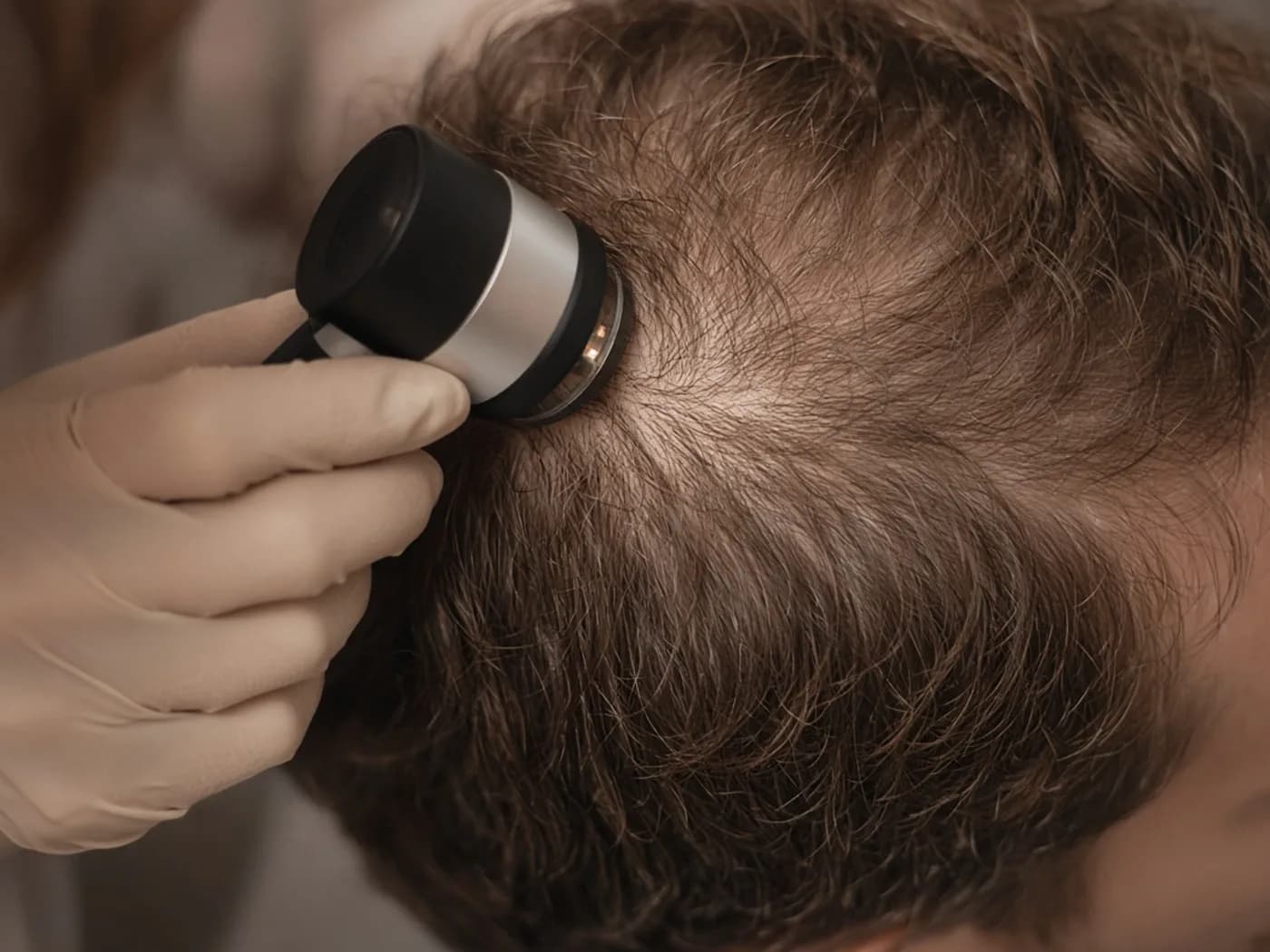
Zuerst: Welche Art von Haarausfall ist das?
Diffuser Ausfall, musterförmiges Ausdünnen und fleckförmiger Verlust haben unterschiedliche Ursachen. Bluttests helfen vor allem bei diffusem Ausfall; musterförmiges Ausdünnen wird meist allein durch die Untersuchung der Kopfhaut erkannt.
Diffuser Ausfall
Mehr Haare in der Dusche, überall.
Denken Sie an telogenes Effluvium und systemische Auslöser.
Musterförmiges Ausdünnen
Wirbel, Schläfen, ein breiterer Scheitel.
Denken Sie an androgenetische Alopezie — meist allein durch Untersuchung erkannt.
Fleckförmiger Verlust
Deutlich kahle Stellen.
Ein anderes Gespräch — oft Alopecia areata.
Zuerst zum Arzt oder Dermatologen beiNarben oder glänzender Haut · schmerzender, entzündeter Kopfhaut · sich schnell ausbreitenden Stellen · Verlust von Augenbrauen oder Körperhaar · allgemeinem Krankheitsgefühl.
Der Bluttest sollte dem Muster folgen, es nicht ersetzen.
Informationsinhalt, keine ärztliche Beratung. Plötzlicher, fleckförmiger, vernarbender oder anhaltender Haarausfall gehört in eine ärztliche oder dermatologische Abklärung.
Welche Bluttests sind bei dünner werdendem Haar sinnvoll?
Das hängt vom Muster ab. Bei diffusem Ausfall werden am häufigsten ein großes Blutbild mit Ferritin und ein Schilddrüsentest (TSH, manchmal freies T4) erwogen. Vitamin B12, Vitamin D, Zink und Hormontests kommen nur hinzu, wenn Ernährung, Medikamente, Beschwerden oder Vorgeschichte darauf hinweisen.
Sollte ich Eisen, Biotin oder Zink gegen Haarausfall einnehmen?
Nicht blind. Nahrungsergänzung hilft, wenn ein Test einen echten Mangel zeigt. Ohne Mangel lässt zusätzliches Eisen, Zink oder Vitamin D selten mehr Haar wachsen, und manches — etwa hochdosiertes Zink oder Biotin — kann Nebenwirkungen haben oder Laborwerte verfälschen.
Brauche ich vor einer SMP oder Haartransplantation einen Bluttest?
Für eine Density-SMP ist keine Routine-Blutuntersuchung nötig. Ist Ihr Ausfall aber diffus oder plötzlich, bitten wir Sie, ihn zuerst von Ihrem Hausarzt oder Dermatologen abklären zu lassen, denn eine Dichteplanung während aktiven Ausfalls führt zu einem irreführenden Ergebnis. Vor einer Transplantation gehört eine standardmäßige präoperative Blutuntersuchung zur medizinischen Vorbereitung.
Häufig gestellt
Ehrliche Antworten
Will my scalp look like a tattoo?
No. Each dot is sized to match a real follicle (0.5–1.2 mm) and placed at irregular spacing. At conversational distance the result looks like denser hair — not pigment.
Can I shave my head after density SMP?
You can shave or cut your hair to any length. The dots remain visible at any haircut. In fact, density SMP is often combined with a shaved-look approach for clients who prefer a clean, even appearance.
Will the dots fade or turn blue?
High-quality SMP pigments are carbon-based and engineered to fade through neutral grey to translucent — never through blue or green. The "blue scalp" you may have seen on bad cases is the result of cheap iron-oxide tattoo inks.
How does it feel during the session?
Most clients describe it as a 2–3 out of 10 — closer to a light scratching sensation than tattoo pain. We use topical numbing throughout. You can listen to music, watch a film, or doze.
Weiterlesen
Verwandte Leitfäden


Beginnen Sie mit einer kostenlosen Aufnahme.
Keine Kosten. Keine Verpflichtung. Wir sagen Ihnen ehrlich, ob eine Operation das Richtige ist oder ob ein nicht-chirurgischer Plan Ihnen besser dient.