Scar Camouflage: How SMP Makes Scars Invisible
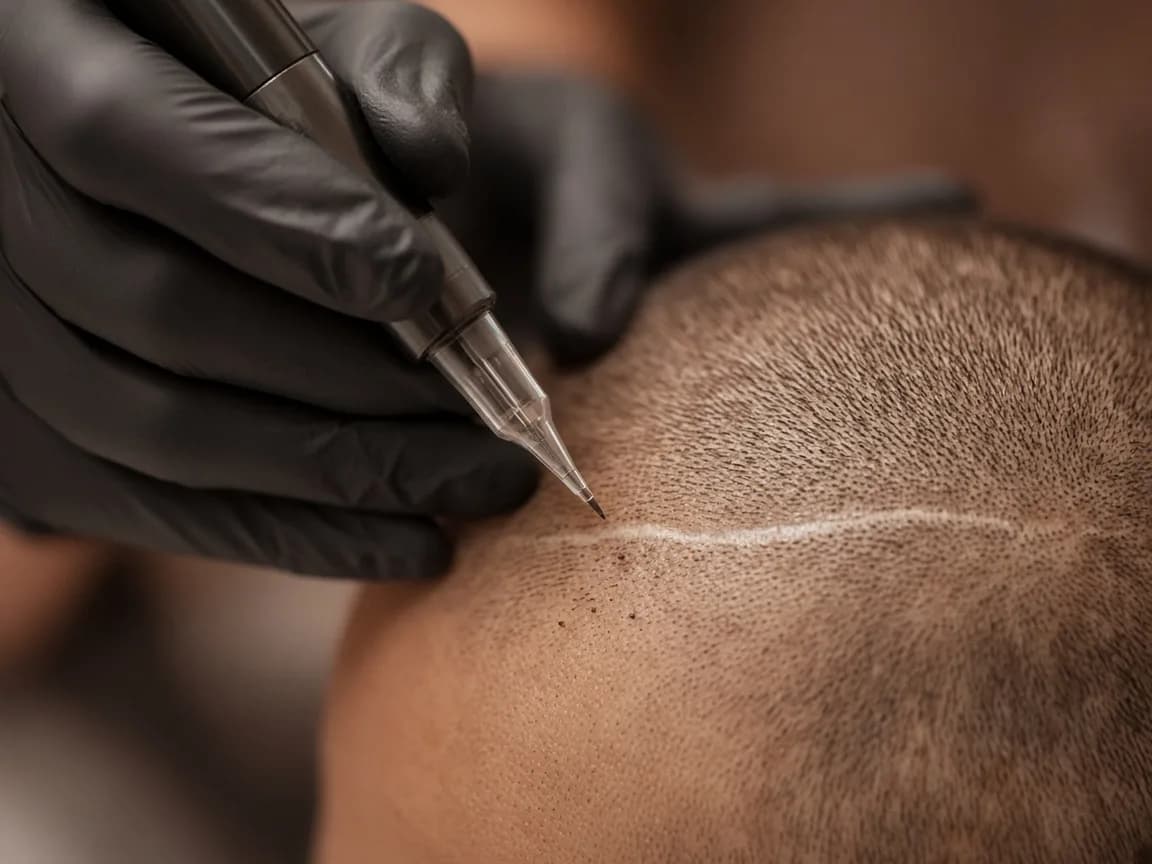
FUT strips, FUE dots, burns, or surgical scars — a deep look at how precision pigment work restores a natural scalp appearance.
Why Scars Stay Visible
A scar is a region where the skin healed without follicles. No follicles means no shadow, no colour break, no texture variation — just a flat patch that catches light differently from the surrounding scalp. That is why scars become more visible the shorter you cut your hair, even decades after they form.
SMP works because it puts the missing visual signal back: thousands of micro-dots that mimic the shadow of follicles in the scar area, blending it into the surrounding scalp at typical hair lengths.
Scar Types We Treat
The same technique covers a wide range of scar origins:
- FUT (strip) scars — linear, occipital, often 12–18 cm long
- FUE dot scars — thousands of 0.7–1.0 mm dots, visible when the hair is shaved short
- Burn scars — usually thicker tissue and unpredictable pigment uptake
- Surgical and trauma scars — neurosurgery, head trauma, accidents
- Camouflage of poor older transplants ("doll’s hair" patterns)
How Scar Tissue Behaves Differently
Scar tissue does not absorb pigment the same way healthy skin does. A first session in scar tissue may take only 30–50% of the pigment a normal session would. That is expected. We layer the pigment over 2–3 sessions, allowing each to settle, then assess what was retained and add what is needed.
The realistic expectation is dramatic improvement, not perfection. A bright pink linear scar after a haircut becomes invisible at 6 mm hair length. A heavily textured burn scar becomes far less obvious but may still show texture under direct lighting.
When Scars Are Suitable for SMP
A scar is generally ready for camouflage when:
- It is at least 12 months old (fully matured)
- The colour has stabilised (no longer pink/red)
- The texture is flat or only mildly raised
- There is no active infection or inflammation
- You have realistic expectations about reduction, not erasure
The Treatment Plan
Scar camouflage typically runs 2–3 sessions at €490–€990 per session depending on size. Sessions are spaced 3–4 weeks apart (longer than standard SMP) to allow scar tissue to settle. Final assessment is at 6 weeks after the last session.