
Hair transplant
FUE Hair Transplant
Follicular Unit Extraction — the modern gold standard for natural-looking hair restoration without a linear scar.
Session length
6–9 hours
Grafts per session
1,500 – 4,500
Recovery (visible)
7–14 days
Final result
12–18 months
Anaesthesia
Local only
Donor scar
Tiny dot scars only
Follicular Unit Extraction (FUE) is the most widely performed hair-transplant technique in the world. Each donor follicle is removed individually with a 0.7–1.0 mm punch — leaving only pinpoint scars that disappear into a normal short-back-and-sides haircut.
At VANC Clinic, your full intake, donor assessment and 12-month aftercare programme are handled at one of our four studios in Belgium and the Netherlands. The surgical procedure itself is performed by our international surgical partner, with whom we have an established medical and quality protocol.
How FUE Works, Step by Step
FUE is a two-step procedure. First, donor follicles are extracted one at a time from the back and sides of the scalp (the safe zone, where hair is genetically resistant to balding). Second, recipient channels are made in the thinning or bald area and the grafts are placed into them at the correct angle, depth and direction.
- Step 1 — Donor area trimmed to 1–2 mm and anaesthetised locally
- Step 2 — Each graft (containing 1–4 hairs) extracted with a 0.7–1.0 mm punch
- Step 3 — Grafts stored in chilled holding solution to maximise survival
- Step 4 — Recipient channels created at the planned hairline and density
- Step 5 — Grafts implanted one by one, each at the planned angle and direction
- Step 6 — Bandaging, photos, post-op instructions, and overnight recovery
Why FUE Replaced FUT for Most Cases
FUT — the older "strip" method — removes a single ribbon of donor scalp and leaves a permanent linear scar. FUE removes follicles one by one and leaves only pinpoint scars that are invisible at any haircut length above about 3 mm. For nearly all aesthetic cases, this is the right trade-off.
FUT can still be appropriate when very large graft counts are needed in a single session, or when the donor density is too low for FUE to be efficient. Our intake assessment will tell you which is the right fit for your specific case.
What Determines a Great Result
Three variables drive every outcome:
- Hairline design — the macro-geometry and micro-irregularity of the front line
- Graft survival — protected by short out-of-body times and atraumatic placement
- Density gradient — single-hair grafts at the front line, multi-hair grafts behind
The Day of Surgery
You arrive in the morning, are checked in by the patient co-ordinator, and meet the surgeon for a final hairline review and design approval. Local anaesthesia takes 30 minutes to take effect, after which the procedure is comfortable. Most patients listen to music, watch a film, or doze through the central hours.
You leave the same day with a custom protective cap, written aftercare instructions, the first set of medications, and a personal contact for anything that comes up overnight.
Recovery — A Realistic Timeline
Crusts form around each graft within 48 hours. They begin softening on day 4 with the first wash and fall off naturally between days 8 and 14. The transplanted hairs themselves shed at week 2–4 (this is the expected shock-loss phase — the follicle remains under the skin). New growth emerges from month 3, density builds visibly through months 6–12, and the final result is judged at 12–18 months.
Suitability
Is this the right procedure for you?
Best for
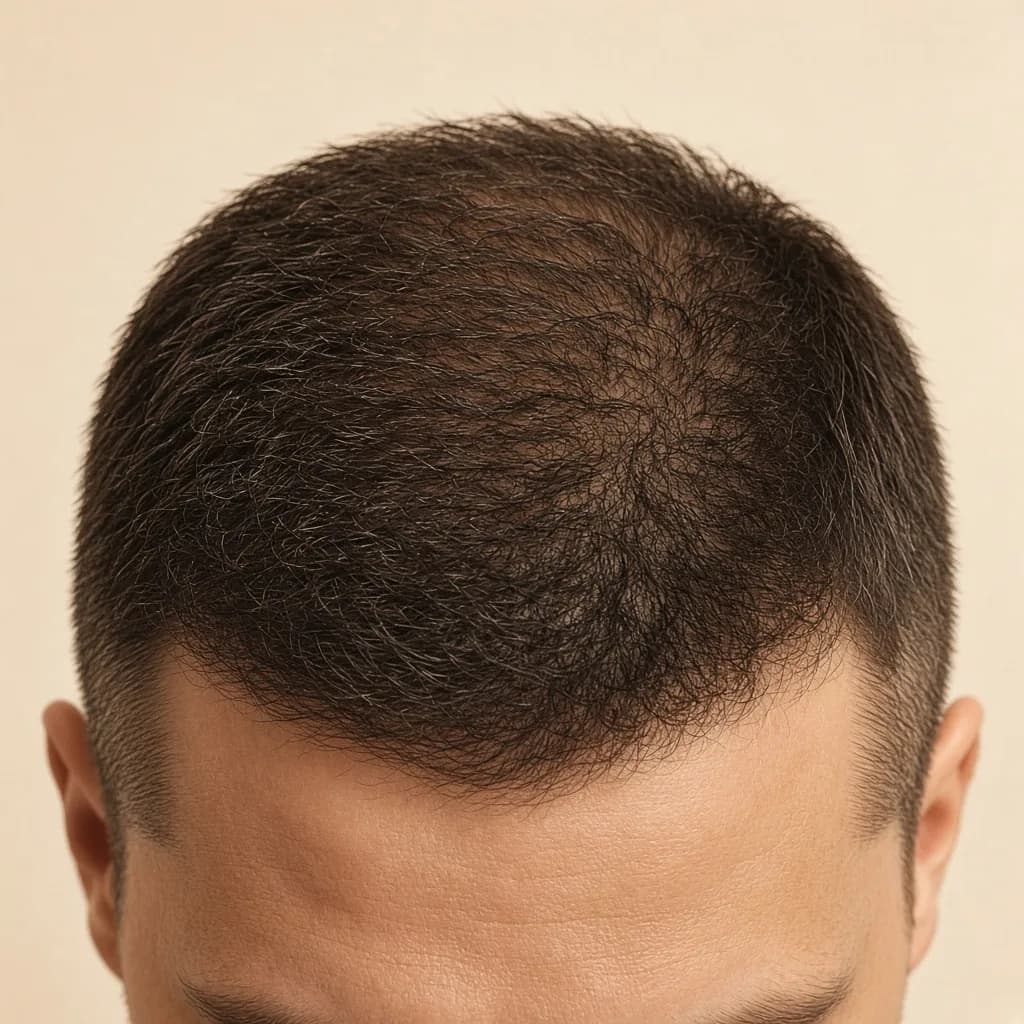
- Receding hairlines (Norwood II–V)
- Crown thinning
- Targeted density restoration
- Beard, eyebrow, sideburn restoration
- Repair work over older transplants
- Patients prioritising no visible scar
Not the right fit when
- Active alopecia areata or scarring alopecia (wait for stability)
- Very low donor density without supplementary plan
- Patients unwilling to commit to medical hair-loss management
- Unrealistic expectations of immediate density
The package
What is included
The figure you sign at intake covers everything below. No itemised invoices, no surprise add-ons.
Frequently asked
Honest answers
How painful is FUE?
The procedure itself is not painful — local anaesthetic completely numbs both the donor and recipient areas. Most patients rate the experience 2–3 out of 10 in terms of discomfort. Mild soreness in the donor area for 3–5 days afterwards is normal and managed with paracetamol.
How many grafts do I actually need?
Graft count is determined by the size of the area being treated and the density goal. Hairline reset typically needs 1,500–2,500 grafts. Hairline + crown coverage: 3,500–4,500. Full Norwood V coverage: 4,500–5,500. We do a full graft-count assessment at intake and quote based on your specific case — we never start from a "package" number.
Will my hair look fake?
A great result is indistinguishable from native hair, even at close range. The most common cause of fake-looking transplants is poor hairline design and the use of multi-hair grafts in the front row. Our surgical partner uses single-hair grafts in the first 1–2 rows and matches angle and direction precisely.
What if I keep losing native hair after the transplant?
Transplanted follicles are genetically resistant to balding — they will keep growing. Native hairs around them may continue to thin if you do not maintain the hair-loss progression with finasteride or minoxidil. We discuss this honestly at intake and recommend a maintenance plan that fits your situation.
How is the surgery handled if I am based in BE/NL?
Everything except the surgical day itself happens at our clinics in BE/NL. Intake, design, bloodwork review, and 12 months of post-op follow-ups are all here. The surgical day is at our international surgical partner — we co-ordinate flights, transfers, hotel, and accompany you through the procedure week. You return to BE/NL to complete the recovery with us.
Continue reading
Related guides



Start with a free intake.
No cost. No obligation. We will tell you honestly if surgery is the right fit, or if a non-surgical plan would serve you better.