The 7 Most Common Types of Hair Loss in Men

From receding hairlines to diffuse thinning — understand the Norwood scale, spot your pattern, and know which treatments actually work.
Why Pattern Matters More Than Cause
Treating hair loss without first identifying the pattern is like prescribing antibiotics without a diagnosis. Pattern tells you the mechanism — and the mechanism tells you which treatment will actually help.
Below are the seven patterns we see most often at intake. Most men present with one dominant pattern, but two of them often co-exist (for example a Norwood III hairline with a Norwood IV crown).
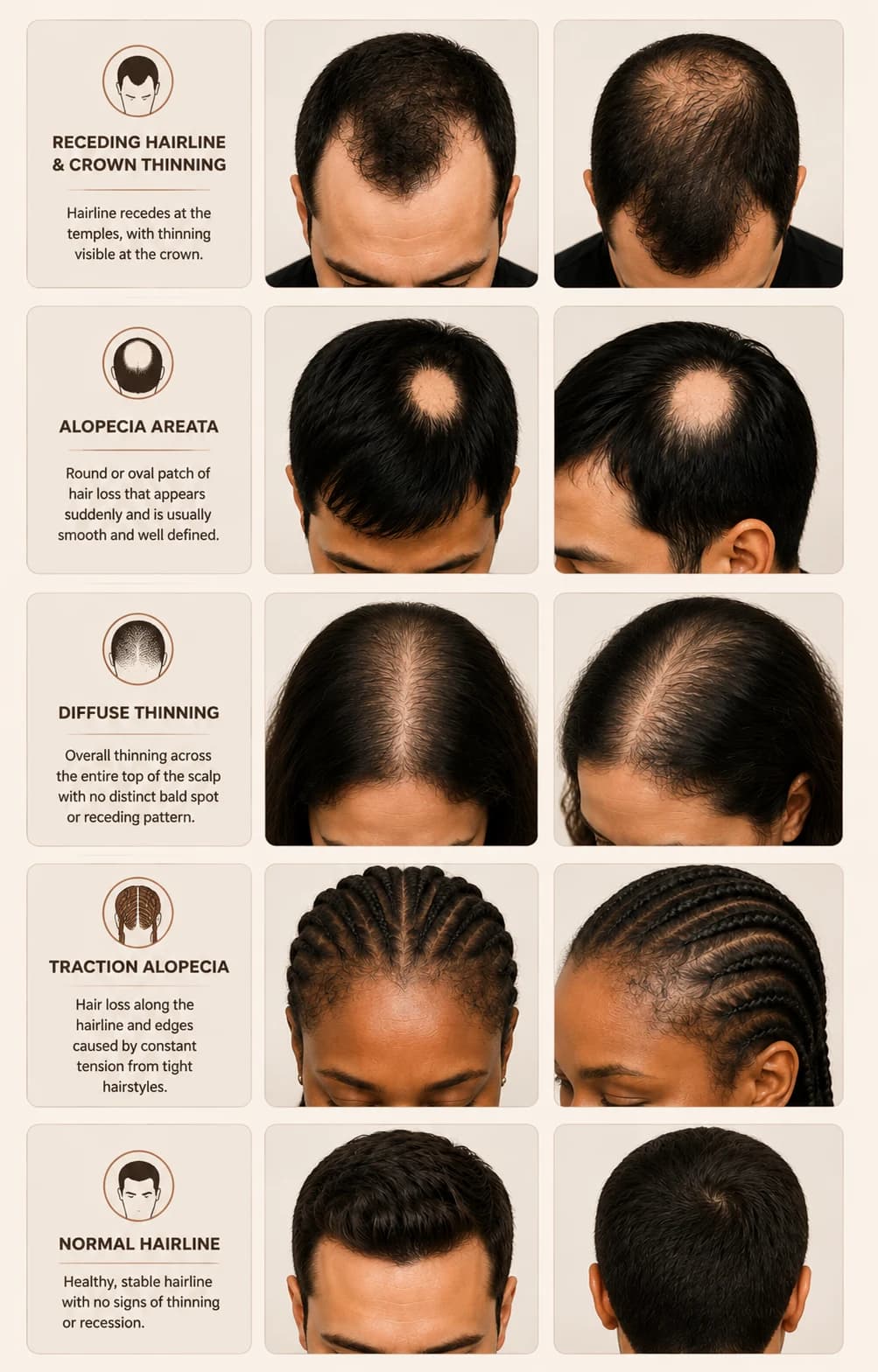
Patterns overlap more often than people expect, which is why the assessment and the history decide the diagnosis, not a single photo.
1. Receding Hairline (Norwood II–III)
The most common starting point. The frontal hairline retreats from the temples first, leaving an "M" shape. Genetic. Slow but steady. Responds well to early finasteride and to hairline-focused SMP or FUE.
2. Vertex (Crown) Thinning
A widening spiral whorl at the back-top of the scalp. Often unnoticed by the person themselves until a barber points it out. Crown loss is graft-hungry — many cases are better served by SMP density work than a transplant.
3. Diffuse Thinning Across the Top
Even thinning across the entire top of the scalp without a clear hairline retreat. Often signals diffuse androgenetic alopecia or chronic telogen effluvium. Bloodwork (ferritin, thyroid, vitamin D) is essential before any surgical plan.
4. Norwood VI–VII Advanced Loss
Bare top with a horseshoe of permanent hair around the back and sides. Donor density determines whether full restoration is realistic. SMP shaved-look or a combined SMP + FUE plan is often the most cost-effective route.
5. Alopecia Areata
Sudden circular bald spots, often coin-sized. Autoimmune. Can resolve on its own, can recur, can progress. Not a transplant case until the pattern is stable for 12+ months.
6. Traction Alopecia
Recession at the temples and frontal hairline caused by tight haircuts, dreadlocks, or chronic tension. Reversible if caught early; permanent if the follicle has scarred. SMP works well for the late-stage, stable cases.
7. Scarring Alopecia
A group of conditions (lichen planopilaris, FFA, central centrifugal) where the follicle itself is destroyed. Surgery rarely takes. SMP can camouflage the pattern once the disease is stable.