The Norwood Scale Explained — Stage by Stage

Norwood I through VII, with the realistic timeline, treatment options and visual signature of each stage. The single most important map of male pattern hair loss.
A 7-Stage Map of Male Pattern Hair Loss
The Hamilton-Norwood scale is the most widely used classification of male androgenetic alopecia. It runs from Norwood I (no clinically significant loss) to Norwood VII (only the lateral and posterior horseshoe of donor hair remains).
Knowing your stage matters because it predicts how the loss will progress, what donor capacity you have for transplant, and which treatments are realistic.
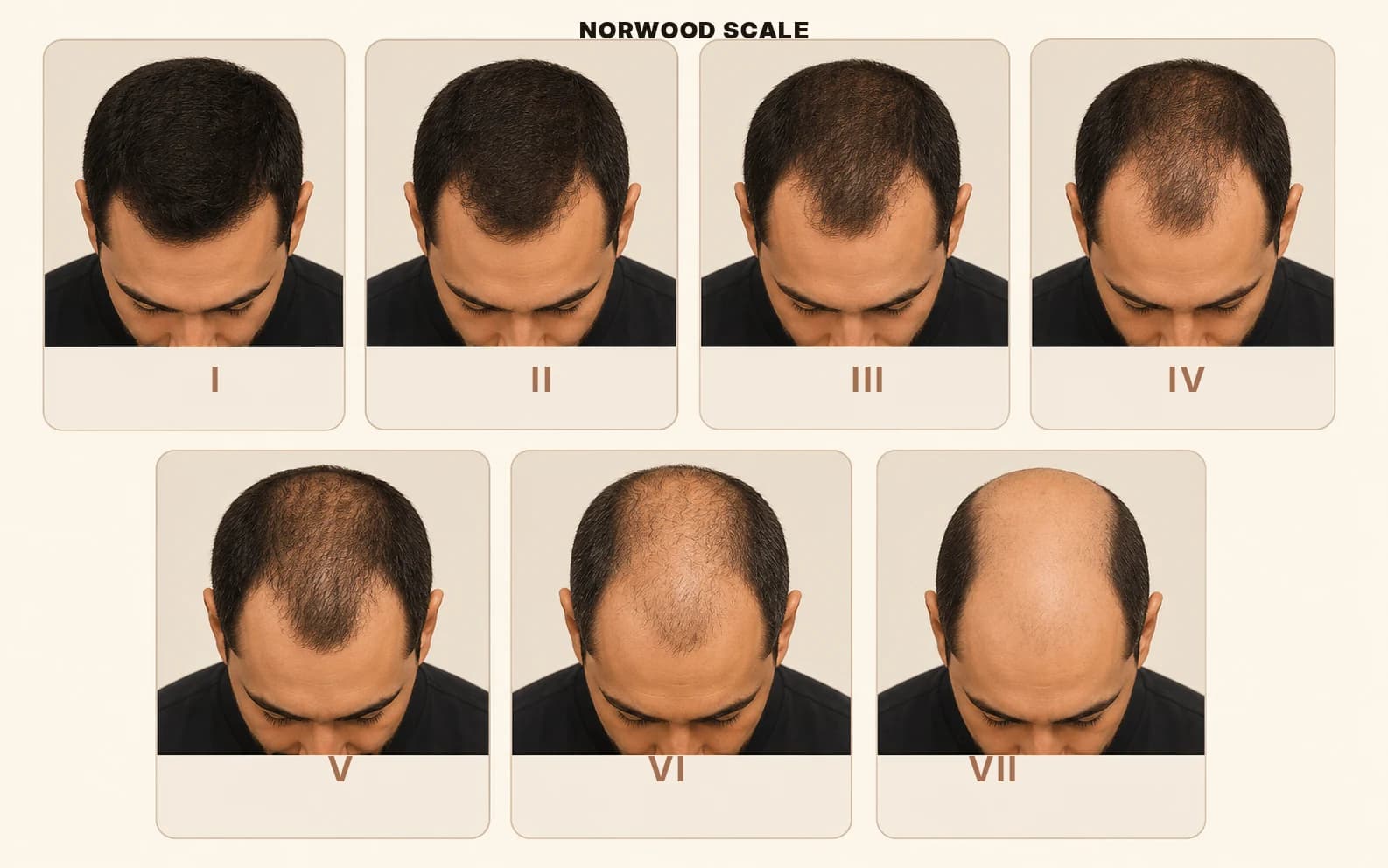
The Norwood scale. From stage V a shaved look is often more convincing than a thin transplant.
Norwood I — Adolescent Hairline
No clinically significant recession. The hairline sits where it has sat since puberty. Most men in their teens and early 20s. No treatment indicated. Photograph annually for baseline.
Norwood II — Mature Hairline
Slight temple recession of 1–2 cm — anatomically normal as a hairline matures. About 95% of men reach this stage by their late 30s. SMP is rarely indicated. Finasteride may be considered if family history is heavy.
Norwood III — The Tipping Point
Temple recession deepens; an "M" shape becomes obvious. This is the stage where men typically start looking at solutions. Excellent stage for medical treatment (finasteride + minoxidil), early FUE, or hairline SMP.
Norwood III Vertex — Crown Joins
III hairline + visible crown thinning. The pattern that defines most cases of moderate hair loss in men aged 35–50. Usually a multi-zone plan: medical therapy + SMP density or split FUE / SMP combo.
Norwood IV — V — VI: The Bridge Disappears
The bridge of hair between the receding hairline and the thinning crown narrows (IV) and finally disappears (V/VI). Donor capacity determines what is realistic. Many cases at this point are better served by an honest SMP shaved-look conversation than another expensive transplant attempt.
Norwood VII — The Final Pattern
Only the horseshoe of permanent donor hair remains. Full restoration is rarely realistic. SMP shaved-look produces a clean, modern outcome — many clients prefer it to a thin, see-through transplanted top.
Speed of Progression
Norwood is a snapshot — it does not tell you how fast you will move between stages. Men with a strong family history of early baldness can move from II to V in 8–12 years. Others stop at III for life. The best predictor is family pattern on both sides, plus serial photographs every 6 months.