Why Needle Depth Decides 80% of Your SMP Result

The dermal layer is 0.4 mm deep on the scalp. Hit it perfectly and the dot lasts. Go too deep and it spreads. Go too shallow and it disappears.
The 0.4 mm Window
The dermis under the scalp is a thin band of tissue roughly 0.3–0.5 mm thick. Below the dermis is the subcutaneous fat, where pigment will spread and look smudged. Above the dermis is the epidermis, where pigment is constantly shed with skin turnover. The dermal mid-layer — about 0.4 mm deep — is the only stable address for SMP pigment.
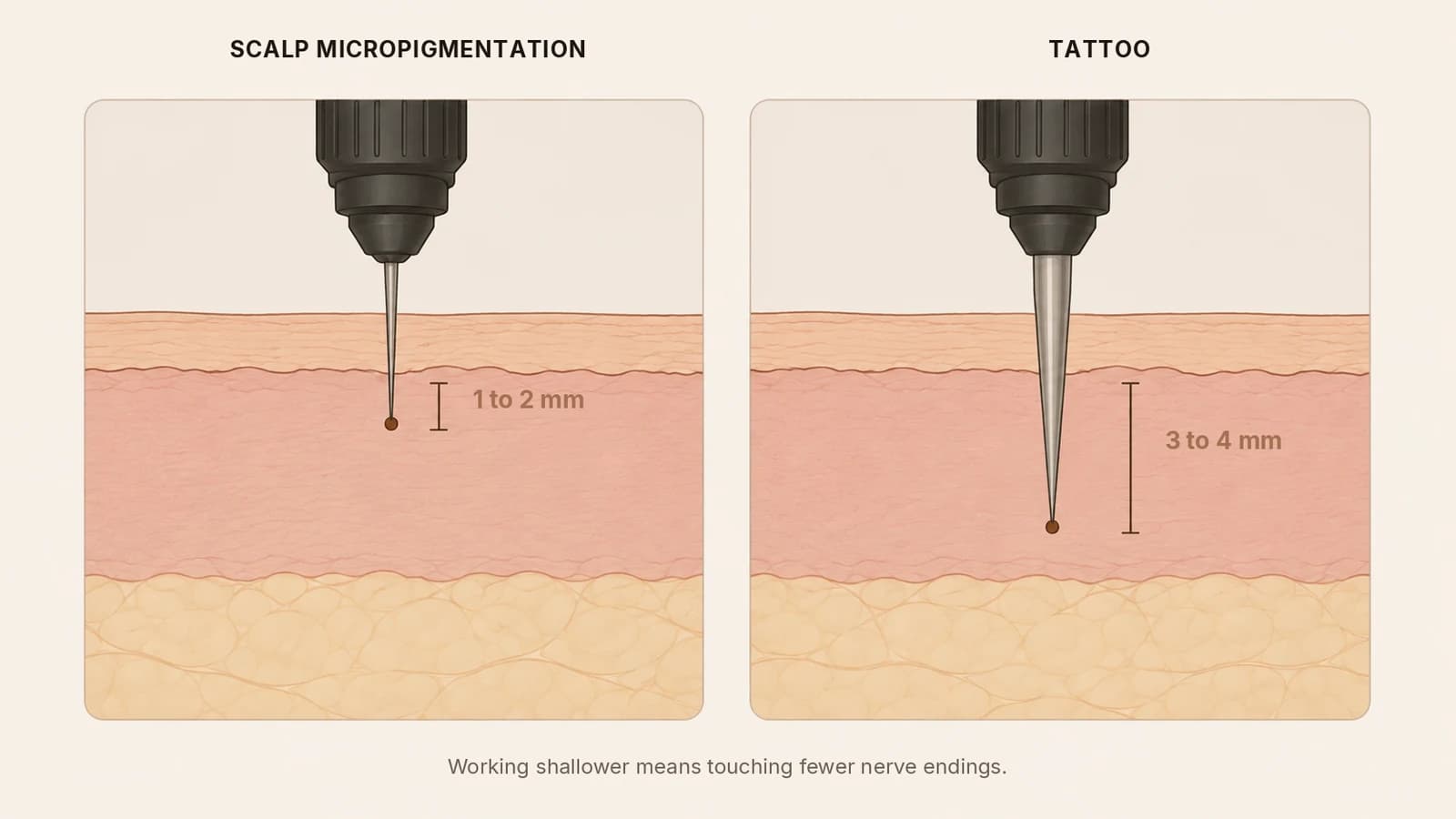
SMP stays at 1 to 2 mm. A tattoo goes twice as deep.
Too Shallow: The Disappearing Dot
A dot placed in the epidermis sheds within weeks as the skin turns over. The classic sign of a too-shallow session is a beautiful result on day one that has lost 60–80% of its density by week 4. Often blamed on "the body rejecting it" — actually a depth error.
Too Deep: The Bleeding Spot
A dot placed below the dermis will spread along the loose subcutaneous fat. The result is a fuzzy, oversized dot or even a continuous smudge. Once placed too deep there is little you can do other than laser correction. This is the failure mode that produces the "blue helmet" look.
How a Skilled Practitioner Calibrates It
Needle depth is set by the device, but felt by the practitioner. The right resistance, the right amount of pigment "tap," the right skin response — all calibrated within minutes of starting on a new client and recalibrated as you move from forehead to crown (where the skin is thinner) to nape (where it is thicker).