The Chemistry Behind SMP Pigments — Why They Stay Black

Carbon-based vs. iron-oxide pigments, particle size, and the reason cheap inks turn blue. The science nobody explains at a sales call.
Why Pigment Choice Decides Whether You Stay Black or Turn Blue
Tattoo inks are pigment compounds suspended in a carrier (usually glycerin or alcohol). They are formulated for permanence in the dermis — but not for predictable fading. SMP pigments are a different category: engineered to fade through gracefully neutral tones.
Carbon vs. Iron Oxide
High-quality SMP pigments are carbon-based. Carbon as a particle is chemically inert, large, and breaks down only very slowly under UV — fading evenly through warm grey to translucent invisibility.
Cheap inks rely on iron oxide. Iron oxide pigments include red, yellow and black components blended to look "black" out of the bottle. The warm components fade fastest, leaving the residual blue/green undertone behind. That is why an old tattoo looks blue.
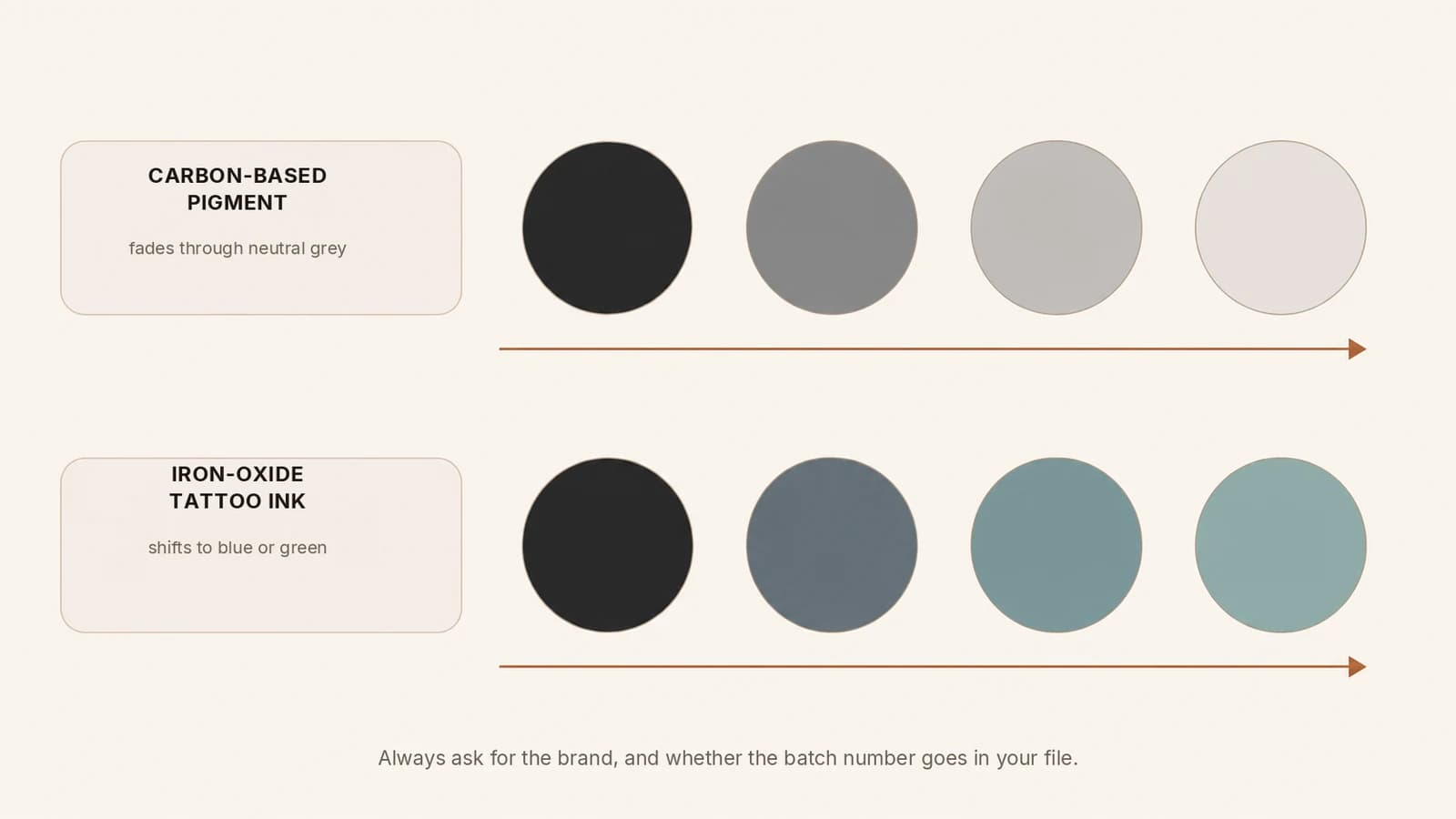
The blue scalp you see in old cases comes from iron-oxide ink, not from proper SMP pigment.
Particle Size and Why It Matters
A pigment particle that is too small is engulfed by macrophages and rapidly removed (premature fade). One that is too large pools and produces a visible dot or even a small lump. The optimal particle size for SMP is roughly 1–10 micrometres — large enough to be retained, small enough to look like a follicle.
Custom Blends per Skin Tone
Black pigment over fair skin can read too cool. We dilute the carbon stock pigment with a sterile carrier to soften the contrast. The opposite is true for very dark skin — undiluted pigment may not provide enough contrast and we deepen it. The pigment that goes into your scalp at session one is mixed in front of you.
Single-Use Cartridges and Sterility
Every cartridge is single-use, individually sealed, and disposed of in front of you at the end of the session. Pigments are CE-certified and traceable by lot number — we keep records on file in case of any future skin reaction.